
Your Comp Set Can Imitate Everything but Your Team
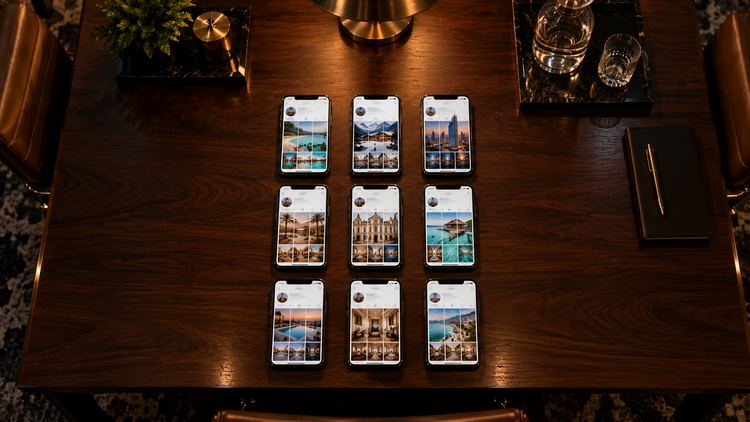
Pull up five Instagram pages from hotels in your comp set. Strip away the names and logos, then inspect the posts. Can you identify which property belongs to which account?
Probably not. Neither can your guests. There’s the drone shot backing away over the water, the same water every hotel in your comp set is filming. The infinity pool aligned with the horizon. A person in a robe on the bed, lowering a strawberry into chocolate. Two hands tipping a drink over ice. A towel folded into an animal. Everyone is working from the same shot list, because everyone hired someone who was trained on that same shot list.
That glossy style once signaled premium. Now it feels cookie-cutter, or even fake. For two years, guests have gotten better at recognizing content that a human probably didn’t create, and they bring that same skepticism to photos you actually paid a real photographer to shoot. When your feed resembles a prompt output, nobody applauds the production spend. What you get instead is suspicion.
There is exactly one asset on your property that no comp set can duplicate. It’s on duty right now, wearing a uniform.
The shift everyone is naming incorrectly
People in the industry call it the transition from UGC to EGC: user-generated content to employee-generated content. Hotels have depended on guest content for more than ten years, and now the pendulum is moving toward staff. Earlier this year, Sprout Social released a strong overview of the trend, and it’s worth a read.
But most coverage, including that piece, focuses on what hotels should avoid.
Sprout describes employee influencers in two forms: employees who market the brand to their own personal audience, and employees who show up inside the brand’s content. Nearly all of the examples lean on the first model. Hire staff who already have followers. Support them in developing a personal brand. Send them to speaking gigs. Manage internal talent like a boutique agency.
That may work for a software company in Chicago. It breaks down at a resort.
Your front desk agent does not have 40,000 followers. Your banquet captain accepted the role to do the role. If you build personal brands for hourly associates in an industry with our turnover rates, you’re creating an audience with legs. It leaves when they do.
What hotels actually need is the second model: associates appearing in the property’s content while your marketing team handles the camera, the prompts, and the publishing schedule. No HR initiative. No coaching on personal branding. No back-and-forth about who owns the following.
The industry is pursuing the harder version. Use the simpler one.
What it looks like on property
Time is always the first objection. No one has room to trail eleven associates around the property with a camera.
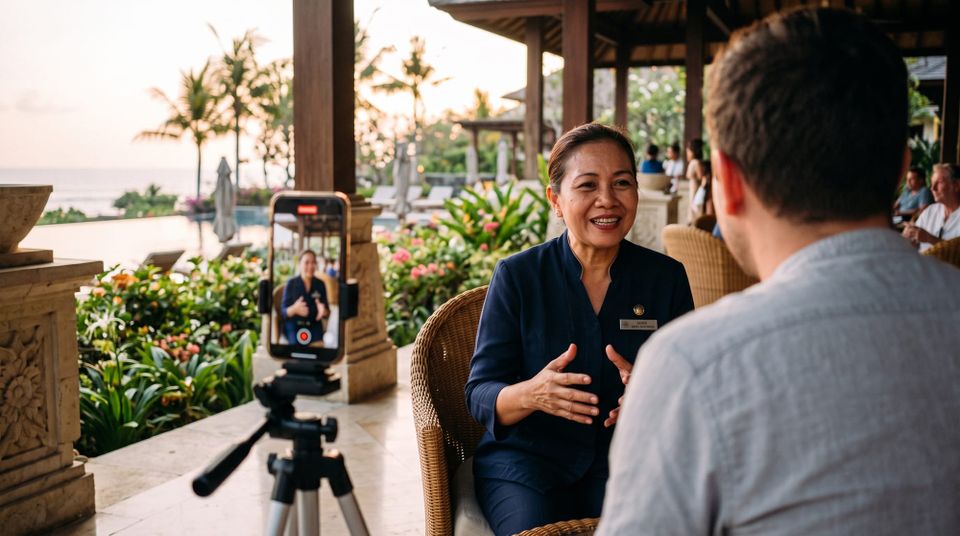
You don’t need to. One associate, one chair, ten minutes. Walk in with fifteen questions and let them talk. What do guests ask you most often? What would you tell a friend coming for the first time? What item on the menu would you order? Where do you send people at 10pm?
Ten minutes of footage can become a dozen short-form videos across different formats and different weeks. Bring in five associates in one afternoon and you can fill the next six weeks without repeating yourself. Ask all five the same question about the restaurant and you’ll get five distinct answers. Those answers are the content. No one sees that and assumes a machine made it.
Two principles matter more than any technical trick. Keep the shoot a little rough. Go handheld, stay slightly off-axis, don’t have anyone staring into the lens, and let the property supply the luxury in the background while the person in front sounds like an actual person. Then get the release signed before anyone sits down, covering likeness and content ownership, so a strong reel doesn’t disappear the week someone resigns.
The associate who says no
Not every employee will want to take part. Don’t force them.
Jamia Kenan, who leads Sprout’s internal creator program, said it clearly: “Audiences can tell when someone doesn’t want to participate.” On a hotel property, that’s more than unhelpful. An uneasy associate on camera comes across as staged, which is the exact effect you were trying to avoid.
Begin with the four or five people who already represent the personality of the building. Every GM knows who they are. The bartender with regulars. The concierge guests request by name. Once those pieces go live and the team sees them, volunteers start appearing on their own.
Kenan’s other line should live on your monitor: think like a director-producer, not a marketer. Your associates are talent now. Hand them a mic, allow a second take, and let them explain it in their own words instead of reading your caption aloud.
Advice to Hotels
Stop pouring the entire budget into the polished asset library. Reserve one two-hour block next month. Sit down with five associates for ten minutes each and leave with six weeks of short-form video. Get the releases signed before the first interview, not afterward. Keep the property in the background and the person in the foreground. Resist the urge to overproduce, because the slight roughness is what makes it feel real.
Your competitors can rent the same photographer, use the same drone, and draft the same caption. They cannot employ your concierge while you do.
We’ve been building this into client programs over the last several months. Early results are strong enough that we’re assembling case studies. Those are on the way.
📊 Stat of the Week
ECN started as a pilot with six people and grew into a pool of about 100 employees, from individual contributors to C-suite executives, all appearing in Sprout's own social content. Less than 8% of their total content mix now drives nearly 8% of total impressions across every channel. If a software company can build a program like that from scratch, a resort with a concierge, a bartender, and a banquet captain already on staff has a serious head start.
📰 Industry Intel
Meta AI Now Analyzes Your Facebook and Instagram Performance Directly
Meta is rolling out new Meta AI features that connect directly to your Facebook and Instagram accounts, Meta Ads, and Google Workspace, letting you ask questions about your own content performance and get answers pulled straight from your account data instead of generic advice.
Impact on Hotels: We've had our eye on this kind of integration for a while, and it makes sense that Meta would be the one to build it. Nobody has better access to your engagement data than the platform that generated it. We're planning to bring this into our own workflow at Casual Fridays, because who better to analyze performance across Meta's platforms than Meta itself. For smaller hotel marketing teams, this is actually an easier lift than it sounds. You don't need a data analyst, you need one person willing to connect the accounts and start asking questions. Larger teams with more stakeholders and more accounts to link will have a heavier setup process, but the payoff, benchmarking your property against comparable brands in seconds instead of hours, applies either way.
Meta Is Quietly Testing the End of Placement Controls
Meta hasn't made an official announcement, but advertisers are seeing placement, platform, device, and operating system controls disappearing from ad sets, with value rules positioned as the replacement lever.
Impact on Hotels: No official word from Meta yet, but screenshots of a live test are a pretty good indication this is headed toward becoming official. We've talked about this pattern before in a past newsletter, when Meta's AI rewrote the text of an ad on its own. Losing the ability to manually exclude a placement is the same story with a different setting. It'll be annoying for hotels that have relied on cutting Audience Network or limiting to certain devices, but this is just where Meta ads are right now, and we're ultimately at their mercy. Meta is betting its AI knows how to run placements better than we do.
Instagram's "First Draft" Auto-Edits Your Reels in Under 10 Seconds
Instagram rolled out First Draft, a feature that automatically trims clips and cuts pauses to assemble a starting edit for a Reel in under 10 seconds, currently live on iPhone and fully reversible before you publish.
Impact on Hotels: This is genuinely cool, but the reach is limited. Most hotel marketing teams have an approval process running through more than one person before anything goes live, and that workflow doesn't disappear because Instagram can cut your clips faster. Where this actually helps is a small team, maybe a single-person marketing department, shooting content and wanting to edit and publish straight from the app without ever touching another piece of software. If that's your setup, this is worth testing. If you're routing every post through a DOSM and a GM for sign off, this saves you ten seconds you weren't going to get back anyway.
Instagram Now Says 3-5 Posts a Week Beats Posting Every Day
Instagram's official business account posted a carousel telling businesses to stop posting for volume's sake, recommending 3-5 posts a week built around a schedule your audience can count on instead of daily content.
Impact on Hotels: We've been asked "how often should we post" more times than we can count, and the answer has always been quality over quantity. This is coming straight from Instagram's own business account, so it carries more weight than another agency's opinion, ours included. Now there's a specific number attached to it. If your property has strong content but not enough of it to publish daily or even five days a week, three posts is more than fine. Stop treating a quiet week as a failure.
Reddit's ChatGPT Citations Dropped 86% in Four Days
Reddit's share of ChatGPT Search citations fell from 3.83% to 0.52% between August 14 and 17, according to Promptwatch, following an earlier decline tied to a query change on August 8. Google's AI products showed no comparable one-day drop, though Reddit's share there has been slipping gradually since July.
Impact on Hotels: This isn't a direct action item for hotels, Reddit citations dropping isn't something you're managing day to day. But it's a real wake up call. Reddit had been riding a massive wave of AI citations for the last year or two, and it disappeared almost overnight because ChatGPT changed how it fans out queries. Nobody voted on that. Nobody got a warning. This is the same lesson we learned in the early days of social media: don't build your house on rented land. Algorithms decide what gets seen, and they can change the rules with zero notice. That's exactly why building your own email list and phone number database matters more now than ever. Those are assets nobody can take away with an update.
✈️ What's Happening at Casual Fridays
Today's travelers search social before they ever hit "book." We put together a new reel using some of our recent property photography, and it makes the case clearly: generic stock photos don't build trust the way dynamic, strategic visuals of your actual property do. Custom content isn't just prettier, it's what turns scrollers into guests.
Our team was on-site in Boston capturing high-impact content for a content visit. Swipe through the carousel to see the highlights, from setup to final shots.


Member discussion