
Your Social Media Reporting Is Missing the Best Part
If your monthly social report is all about likes, followers, and engagement rates, you’re telling your leadership team and ownership group half the story. That’s not entirely your fault. For years, hotels have reported on whatever the platforms said mattered: first followers and likes, then engagement. Now ownership wants ROI from organic social. That’s a tough ask when nearly all of that strategy sits at the top of the funnel, building awareness months before anyone books a room.
What Is Data Storytelling in Social Media?
Data storytelling means turning your social metrics into a clear explanation of what happened, why it happened, and what to do next. Sprout Social just published a piece on data storytelling that names the real challenge. The numbers usually aren’t the issue. Nobody explains what they mean. According to Sprout’s research, only 36% of organizations regularly use social insights to inform decisions outside of marketing. The data is there. It just never leaves the dashboard.
I’d take that a step further for hotels. “Engagement was up this month” is a report, and it gives your GM or ownership group nothing to act on. The story lives in the why. What changed in the content? Who was on camera? What did people actually do with it?
What Happened When Three Florida Resorts Put Associates on Camera
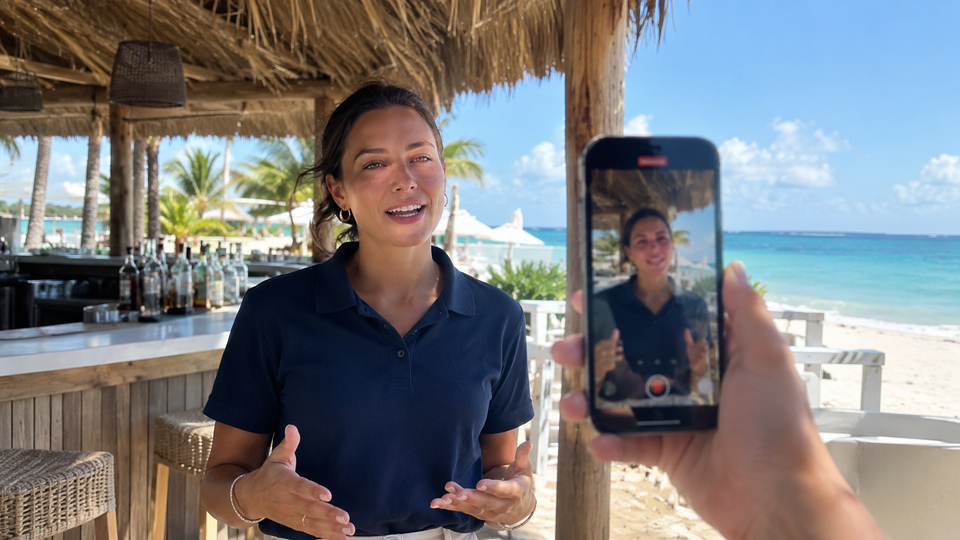
Earlier this year, we tested a shift with three coastal Florida resorts. We put real associates on camera in quick, short-form Reels where they shared their favorite restaurants, spots, and things to do around the destination. No scripts, no models. Average engagement rate jumped 250%. At one resort, a single post pulled more than 100 comments. That property typically averaged 10 to 20.
Why Shares and Saves Matter More Than Likes for Hotels
Those numbers are nice. What your stakeholders need to hear is why they happened. Guests wanted to hear from the people who actually work there, so they shared and saved those posts. A save means someone bookmarked your associate’s restaurant pick for a trip they haven’t booked yet. Shares matter even more for growth. Instagram’s head, Adam Mosseri, has said that shares are one of the platform’s top ranking signals and carry a bit more weight for reaching people who don’t follow you yet. In other words, they reach future guests. Real people on camera earned that kind of attention. That’s the story worth telling.
Advice to Hotels
In your next report, skip the engagement total up top and lead with your best-performing post and why it worked. Name the format, the person on camera, and what the audience did with it. Track shares and saves on their own, because they tell you who’s thinking about a trip. If real associates are what’s working, put that in front of your GM and ask for more of it. Your monthly report isn’t a scoreboard. It’s your best argument for where the content goes next.
📊 Stat of the Week
That’s a lot of missed opportunities sitting in dashboards nobody outside marketing opens. For hotels, it could be a restaurant pick your followers keep saving, or a question guests keep asking in the comments that your sales team never hears about. Get it to your GM while it can still change something.
📰 Industry Intel
Meta Launches Ads Super Burst and Tests First-in-Feed Ads
At its Brand Building Summit, Meta announced Ads Super Burst, which lets advertisers book TV-like reach inside a 3 to 24-hour window, and started testing First Impression Ads, the very first ad someone sees when they open Facebook. Meta is also expanding Reels Trending Ads, which place your ad right after the most-watched Reels, with new topics like Spanish-language content and seasonal lineups around the holidays and football season.
Impact on Hotels: This is one of the more exciting ad updates Meta has put out in a while, and three of these really stand out to us. Super Burst gets you TV-level exposure in a tight window, First Impression Ads put you at the very top of the feed, and Reels Trending Ads put your hotel right next to what people are already watching. They’ve been tested and are rolling out, so stay tuned as we get the chance to try them ourselves. If you’ve got a specific initiative coming up, like a reopening or a new restaurant launch, one of these could be a smart way to make it land.
Meta’s New Business Terms Let It Train AI on Your Website
Meta is updating the commercial terms every business account agrees to, and starting October 30, those terms give Meta permission to automatically scan the websites linked to your Facebook or Instagram business page and use that content to train its AI, according to Ars Technica. Businesses can’t opt out of the new terms without leaving Meta’s platforms, although Meta says sites can still block its crawlers through robots.txt, the file that tells bots which pages they’re allowed to access. Legal experts warn the language is broad enough that Meta could eventually use it to justify scraping content that would otherwise cost millions to license.
Impact on Hotels: This hits news publishers hardest, since their articles are exactly the kind of content they’d normally charge for. Hotels aren’t in that spot, but if you have a Facebook or Instagram business page, your website is now feeding Meta’s AI. That makes it one more reason to get your site buttoned up. Your room descriptions, dining pages, and FAQs should be accurate, specific, and current, because that’s what AI tools are going to reference and cite when travelers ask where to stay.
ChatGPT Traffic Is Showing Up as “Direct” in Analytics
Since around October 9, many clicks from ChatGPT have been reaching websites without the information that tells analytics tools where the visitor came from, so platforms like Google Analytics are counting that traffic as Direct, Search Engine Watch reports. One analysis of roughly 500 pages found about 31,000 fewer daily visits credited to ChatGPT and about 26,000 more Direct visits to the same pages, which means most of those visitors are likely still showing up, just under the wrong label. It may turn out to be a bug, but for now it’s throwing off referral reports.
Impact on Hotels: If your October report shows ChatGPT traffic dropping hard, don’t panic and don’t pull back on your AI search work. Look at total traffic to the same landing pages and check whether Direct went up while ChatGPT went down. If the total held steady, your strategy is doing its job. The tracking just lost the label.
Google Ads Tests Automated Bidding for YouTube Video Reach Campaigns
Google Ads is testing a new option for Video Reach campaigns, the video ads built to put your brand in front of as many people as possible, that lets Google set and adjust your bids automatically instead of you deciding how much to pay per thousand impressions, Search Engine Land reports. Google’s goal is to spend your full budget while reaching the most people, though the trade-off is less control over what you pay. The feature is still in beta.
Impact on Hotels: Most hotels aren’t running YouTube ads at all, and bandwidth is usually a big reason why. This takes one of the more hands-on pieces off your team’s plate. If you’re planning a brand-awareness push around a peak booking season, you can launch video ads without babysitting bid costs every day. Just keep an eye on what you’re actually paying per thousand views, since Google is the one making that call now.
Facebook Now Lets Users Tell the Algorithm What They Want to See
Facebook is rolling out Your algorithm, a new space in the three-dot menu where users can type in the topics they want more of in Feed and Reels, in their own words, Meta announced. Users can also tap “Interested” or “Not interested” on any post and explain why, and Facebook’s ranking system, now powered by AI that understands everyday language, updates their recommendations in real time.
Impact on Hotels: We covered this a couple of months ago when Instagram launched it, and now it’s on Facebook too. If someone tells their feed they want more beach getaways or weekend trips, content that clearly matches that interest can reach them a lot faster. That means your captions and on-screen text should describe what you actually offer in the words a traveler would use, like “oceanfront suites in Naples” instead of “your perfect escape awaits.” Be specific about the experience and the destination, because vague copy gives the algorithm nothing to match.
✈️ What's Happening at Casual Fridays
This is exactly what we talked about in today’s lead story: put real associates on camera. One of the simplest formats you can film is having an associate share their name, their role, and a little about what they do, like Paula from the pool team at one of our client resorts. Watch the Reel on Instagram.
Here’s an example of a trending carousel format for photo posts: we laid the rule of thirds grid over each shot, and when the subject doesn’t sit on the lines, the lines bend to follow them instead. It’s a playful way to share photos you already have and give followers a reason to swipe through. Swipe through it on Instagram.




Member discussion